In this post we go back to the 1950s and look at one of High Wycombe’s forgotten venues, the Cadena Hall, and the High Wycombe Rhythm Club, sometimes known as the High Wycombe Jazz and Rhythm Club, which championed jazz and skiffle music throughout the 1950s.
The entrance to the hall was down an alley way next to Popp’s Newsagents.
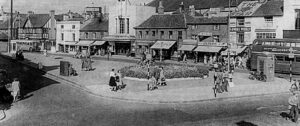
View of Frogmoor – September 1950
Jazz and skiffle played a significant role in teenage culture, alongside the development of rock ‘n’ roll. In nearby Aylesbury, as the jazz boom subsided the local jazz club morphed into Aylesbury Bluesville, presenting British and American blues and ryhthm and blues artists into the 1960s. The transition was less obvious in High Wycombe but there nonetheless.
Cadena Hall in Frogmoor
The Cadena Hall opened in August 1922; the Bucks Free Press reported on its opening.
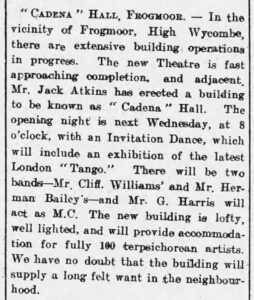
The Cadena played a part of the social life of the town until it was lost under the development of the Chilterns Shopping Centre, which opened in 1987.
High Wycombe Rhythm Club
The club’s roots go back to the the original High Wycombe Jazz Club which was started by Max Jones and Peter Duffle in 1939, first meeting in the White Hart pub before moving to the Cadena. It operated throughout WW2 until 1944.
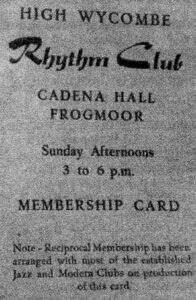
Membership card owned by Pamela Devoy supplied to the Bucks Free Press in 2010
The club was was re-formed in 1951 as the High Wycombe Rhythm Club. Operating on Sunday afternoons, it soon established itself with a growing membership.
The club’s base was the Cadena Hall but it also presented occasional gigs at the Town Hall which had a larger capacity.
During the 1950s most of the major stars of British jazz and skiffle played there. An ad from 1957 shows a list of those who had played.
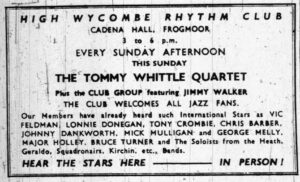
Alongside jazz giants such as Chris Barber, Lonnie Donegan was a key influence on British pop. His obituary in The Guardian read:
Lonnie Donegan was the first British pop superstar, and the founding father of British pop music, the musician who provided the original inspiration for John Lennon, Paul McCartney and a host of others.
As the leader of the skiffle craze in the late 1950s, he inspired the formation of literally thousands of do-it-yourself bands across the country, and was directly responsible for the 1960s pop explosion.
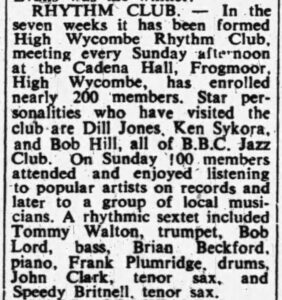
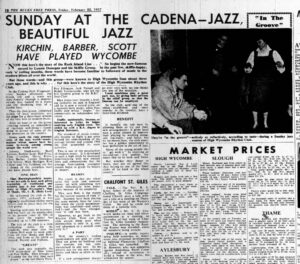
An article from the same year, 1957, in the Bucks Free Press gives a picture of what the club was like.
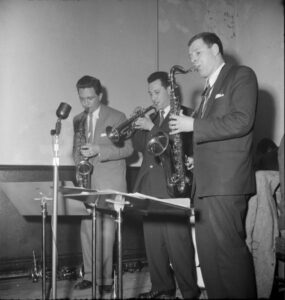
Free Press photographer Ronald Goodearl took other photos at a gig on 10 February 1957; these photos are are now on the SWOP (Sharing Wycombe’s Old Photographs) site, including this one of three musicians:
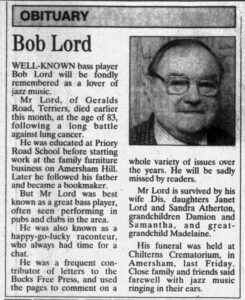
The man behind the Rhythm Club was Bob Lord. Bob died in 1997, aged 83, and his obituary appeared in the Bucks Free Press.
The affection with which the club is remembered was seem in 2010 when the Bucks Free Press asked for reader’s recollections, and many letters were published over two weeks.